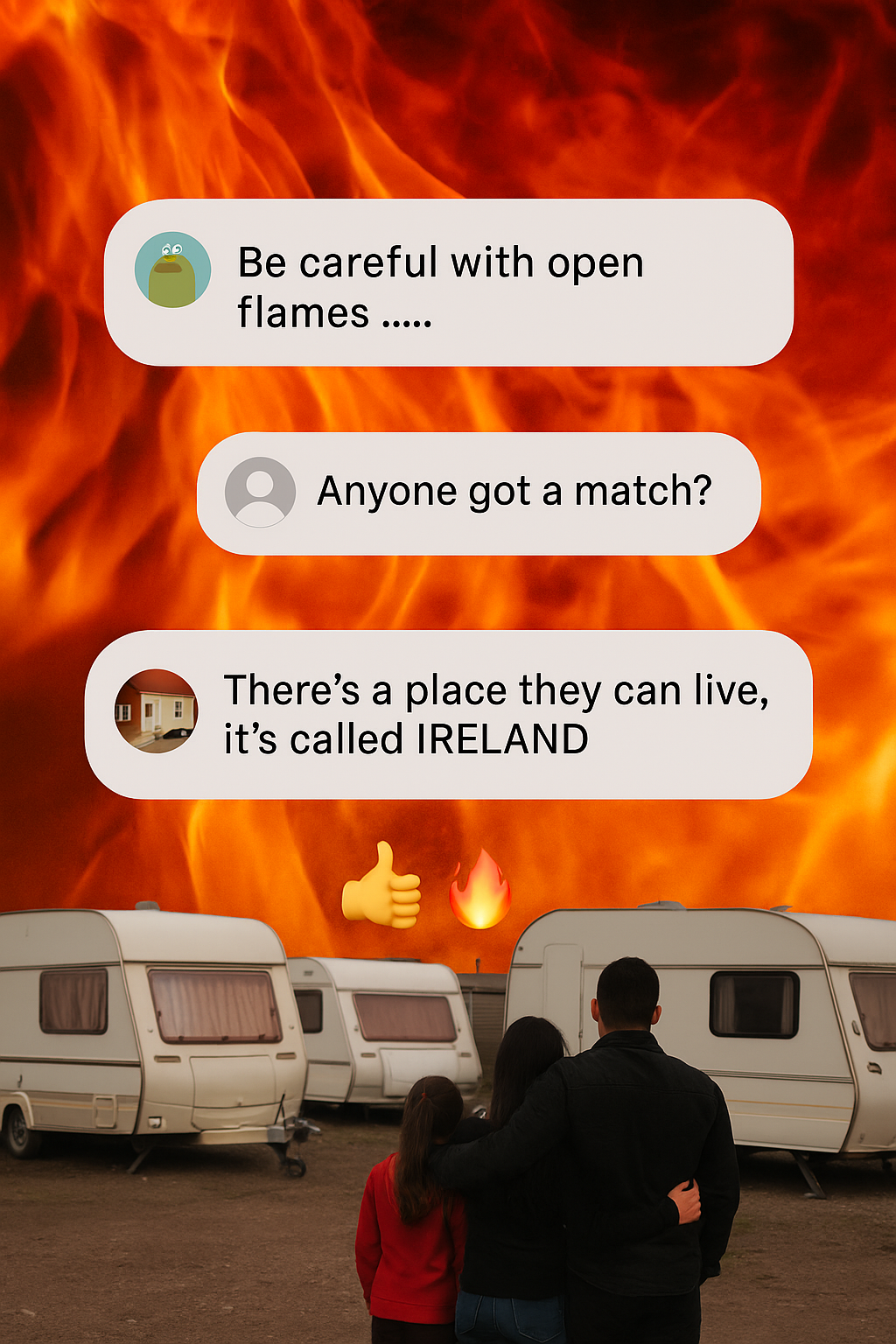
We’re used to hearing it.
“You break the rules.”
“You don’t follow the system.”
“Why can’t you just do things properly?”
Those comments get thrown at Gypsy & Traveller families all the time, as if exclusion is a personal failing rather than a political design. As if the rules themselves are neutral, fair, and applied equally.
They aren’t.
From planning policy to housing law, the rules were never made with us in mind. They were designed to manage us, restrict us, and control us. And when they don’t quite work well enough to do that, they’re changed.
Again. And again.
This is why welfare reports in planning cases matter so much. For many Gypsy & Traveller families, these reports are one of the few formal tools available to make our lived reality visible inside a system that would otherwise ignore it. They document health needs, disability, trauma, safeguarding concerns, and cultural requirements—real lives reduced far too often to planning “considerations.”
But who writes these reports is not a side issue. It is central.
When welfare reports are written by Gypsy people ourselves, they become an act of self-determination. They are produced by people who understand our culture because we live it—and who understand the rules because we have been forced to learn them in order to survive. This is not anecdotal knowledge or “community insight.” It is expertise.
These reports are written by people who know how planning decisions are framed, how welfare evidence is weighed, and exactly where Gypsy & Traveller needs are routinely dismissed. They use the state’s own language, thresholds, and policy tests—without translating our lives into something more “acceptable.” They make arguments that are structurally difficult to undermine and politically uncomfortable to ignore.
This is where non-Gypsy “expertise” so often fails our families.
Too often, external professionals misunderstand culture, minimise harm, or frame Gypsy & Traveller lives through deficit and risk. They prioritise professional neutrality over truth, soften conclusions to avoid challenge, or strip out cultural context in the name of objectivity. In doing so, they produce reports that are technically competent but politically toothless—easy for decision-makers to disregard.
What gets lost is the reality of what enforcement, displacement, and insecurity actually do to our families.
Reports written by Gypsy people do not make those mistakes. They do not need to be convinced that culture matters, that trauma accumulates, or that “temporary” solutions are never temporary for us. They start from that reality and then meet the system on its own terms.
These reports force the system to pause. To acknowledge that planning decisions are not abstract, technical exercises, but choices that directly impact children, elders, and vulnerable families.
Still, even when welfare evidence is clear, it is often treated as an inconvenience rather than a responsibility.
Planning rules, housing policy, definitions of “need,” and enforcement powers are not fixed or impartial. They are shaped by a colonial state that has long viewed Gypsy & Traveller communities as a problem to be contained rather than people to be supported. Rules are tightened when we find ways to survive within them. Loosened when it suits others. Rewritten without us at the table.
And then we’re blamed for not keeping up.
What’s different now—what matters about this work—is that we are no longer being spoken for. We are learning the rules in excruciating detail and using them deliberately. Not because they are just, but because they are unavoidable.
Through welfare reports, planning submissions, and evidence built from lived experience and technical knowledge, we are beginning to carve out small spaces of accountability.
It shouldn’t take this much work.
It shouldn’t take reports, assessments, consultations, appeals, and years of advocacy just to meet needs that have existed for generations.
And yet here we are—marking progress by saying that twelve vulnerable families may finally have a culturally appropriate home by 2026.
Twelve.
In any other context, this would be recognised as a national failure. For Gypsy & Traveller families, it is framed as something close to a success. That alone tells you how deep the inequality runs.
We’re not celebrating because the situation is good.
We’re acknowledging a small shift because the baseline has been so brutally low for so long.
This is the reality of Gypsy & Traveller life in Britain: navigating systems designed without us, resisting narratives that criminalise us, and asserting our right to define our own needs.
Understanding the rules doesn’t mean accepting them.
Using them doesn’t mean agreeing with them.
It means refusing to disappear.
And until equity is real—until culturally appropriate homes are ordinary, not exceptional—we will keep documenting, challenging, and insisting on our own expertise.
Because survival is not rule-breaking.
It’s resistance.