
I was told my whole life that I was English.
English Gypsy.
It wasn’t said harshly. It wasn’t said defensively. It was simply offered as fact, the way families hand down recipes or habits or certain turns of phrase. It was part of who we were. We were English.
And yet, there were the trips to Arbroath,
There were the stories from my dad’s family — stories that didn’t feel English at all. Stories rooted in Scottish soil. Stories spoken in kitchens thick with memory. And there was my mam, who would sometimes say we were from the “Piper Stewarts” — or maybe Stuarts. I wasn’t sure. She never said and I never checked either.
It didn’t feel important then.
It does now.
Because I have just finished reading the Scottish Human Rights Commission’s report, “No Man’s Land: A Human Rights Assessment of the ‘Tinker Experiment’ and Redress for its Victims” — and what it describes is not distant history. It feels uncomfortably close.
The Experiment Beneath the Silence
The report documents what became known as the “Tinker Experiment” — a series of policies stretching from the 19th century deep into the 20th, designed to assimilate Scotland’s Gypsy Travellers into settled society.
Not through encouragement.
Through pressure. Through law. Through fear.
Nomadism was steadily criminalised. Camping was treated as trespass. Travelling families were conflated with vagrancy. A way of life that had existed for generations was reframed as a social problem to be solved. (is this starting to sound familiar?)
The report describes how councils, the Scottish Office, the Church of Scotland, police forces and charities worked, sometimes formally, sometimes informally, toward what they called “absorption” into ordinary society. It speaks of “experiment sites” like Bobbin Mill, where families were moved into converted military huts. Nissen huts with asbestos-lined walls, inadequate sanitation, and no electricity for decades.
These were not improvements. They were containment. And alongside the housing policies came something more devastating.
The removal ,or threat of removal, of children.
The report details how legislation such as the Children Act 1908 was used in ways that allowed children of travelling families to be taken into industrial schools or care homes, particularly if their schooling did not fit the rigid expectations of settled society. Overcrowding in the deliberately inadequate accommodation provided to families was then cited as justification for intervention.
The message was clear: settle, conform, or risk losing your children, but they lost them anyway
It is hard to overstate the quiet terror that must have carried.
A Culture Rewritten
What struck me most was not just the historic detail, but the Commission’s argument that this is not merely history. The report frames the Tinker Experiment as a continuing human rights issue — a pattern of forced assimilation whose effects are still visible today in substandard site conditions, discrimination in housing and education, poorer health outcomes, and enduring cultural marginalisation.
It speaks of forced assimilation as incompatible with international human rights law. It notes that cultural life, the right to maintain traditions, language, identity, was not protected but actively suppressed. Stopping places were closed. Nomadism was equated with criminality. Legislation remained on the books long after the rhetoric softened.
And so the assimilation did not always look dramatic. Sometimes it looked administrative.
Sometimes it looked like being quietly told, over generations, that you are something else now.
That you belong somewhere different.That the old story is best left alone.
The Hat in the Square
My mam used to tell me about her granddad — Townson Stewart. Or Stuart. I really should check!
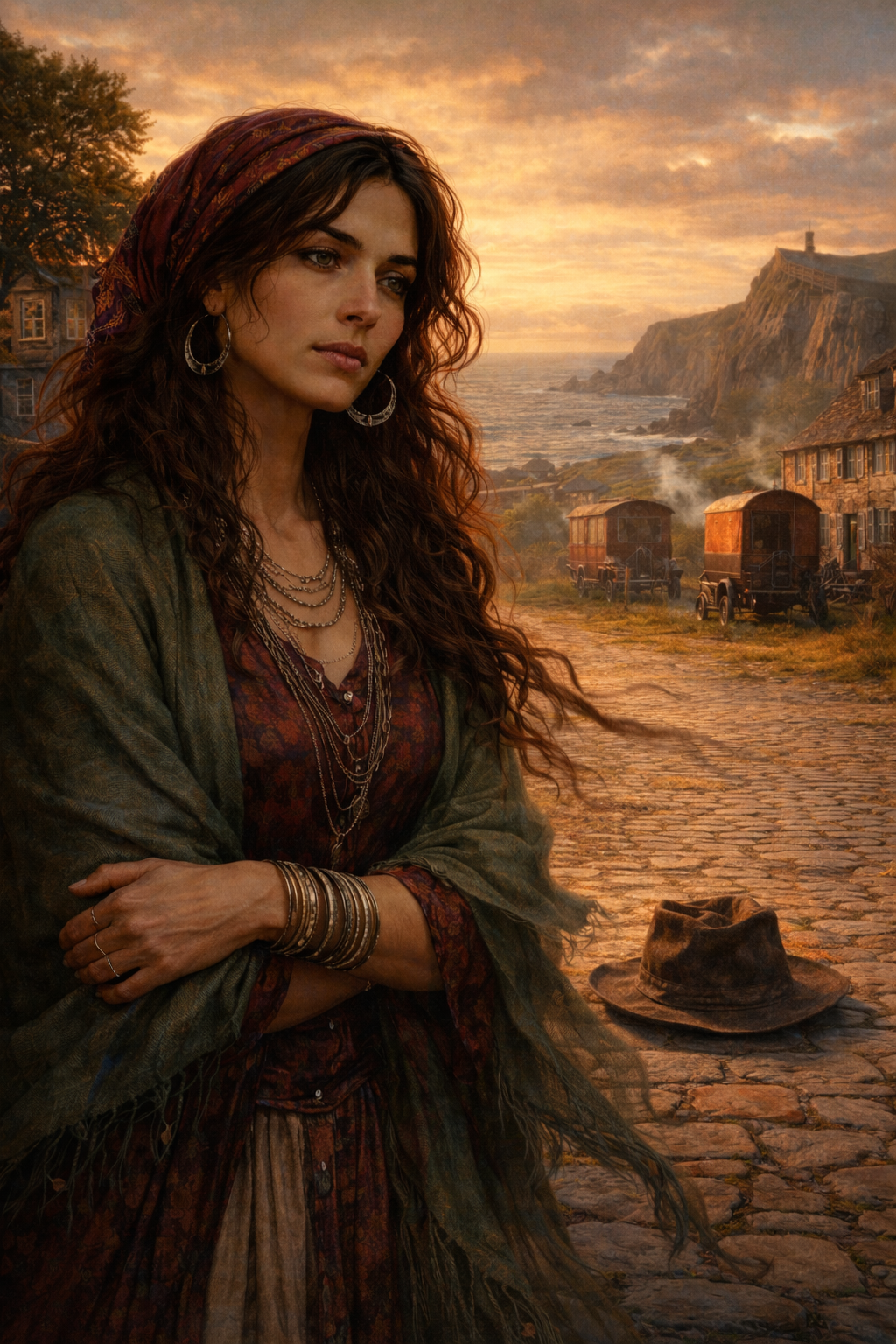
She would describe him walking into a small Scottish village square, throwing his hat into the centre, and declaring that any man brave enough to pick it up could fight him, with a wager agreed beforehand. Obviously!
As a child, I thought it was a story about pride. About a man who enjoyed proving himself.
Reading this report, I hear it differently.
I hear a man standing visibly, unapologetically, in a place that may not have welcomed him.
I hear defiance in a time when legislation was tightening around families like his.
I hear a refusal to disappear.
Throwing down a hat is not only bravado. It is presence. It is a declaration: I am here.
And I cannot help but wonder how long such defiance could hold in the face of policies designed not just to regulate, but to erase. when did Townson decide to head to the border with my Granny Suzanna?
No Man’s Land
The title of the report comes from testimony given by victims who described living in “no man’s land” — neither fully accepted by the settled community nor able to live freely as Travellers.
That phrase lingers.
Because there is another kind of no man’s land.
The one between identities.
The one where you are raised English but feel something tug when Scottish place names surface in family stories. Where your voice finds a light accent when surround by others. The one where a surname shifts slightly in spelling, and no one quite checks. The one where you inherit certainty that may actually be the residue of pressure. the one where your made fun of by other Romani people, because some of your words seem made up to them. the one where you dont have the voice or information to say,
“No its Scottish Cant”
If forced assimilation is successful, it does not always leave obvious scars. Sometimes it leaves confusion. Sometimes it leaves silence. Sometimes it leaves grandchildren who don’t know which story is fully theirs.
Apology — And After?
The Scottish Government apologised in 2025. The Church of Scotland apologised. Perth and Kinross Council apologised.
The report acknowledges those apologies, but it also makes clear they are insufficient on their own. It calls for what it terms a “transformative reparations approach”: financial compensation, culturally appropriate housing, investment in community empowerment, truth recovery around child removals, legislative review, and guarantees that such harm will not be repeated.
It insists that victims and their descendants must lead the process.
And as I sit with that, I find myself asking quietly:
Is this enough?
Is this the beginning of real recognition?
Or are we only at the first careful step?
Recognition is not only institutional. It is personal. It reaches into family narratives. It unsettles the stories we have long accepted.
It asks us to look again.
Picking Up the Hat
I think again of Townson Stewart — or Stuart — and the hat lying in the centre of that village square.
Perhaps this report is its own kind of hat thrown down.
A challenge to Scotland to confront what it did, not as a footnote, but as a structural injustice with ongoing consequences.
But perhaps it is also a challenge to those of us who grew up in the aftershock.
To ask.
To trace.
To check the spelling.
To consider whether “We’re English” was always a declaration of origin — or sometimes a declaration of safety.
Maybe this is the start of recognition.
Not neat. Not complete. Not resolved.
But a beginning.
And maybe, after all this time, that is where we have to begin.
